Sunday, December 23, 2012

Madrid 6th Ward Christmas Party

We attended the Madrid East 6th Ward Christmas Party on December 15, 2012. It was well attended by members of all ages:

Beverly, Miriam, and a new member, Vili, chatted before the party began:

The Relief Society sang two numbers:

The Primary put on a skit. Here Samuel the Lamanite stands on the wall and predicts the birth of the Savior:

Beverly played the piano for two groups, including the Primary:

 The Primary sang several Christmas songs:

The Young Men and Young Women did a skit and a dance:

The missionaries put on a skit. The reindeer were Elders Levorsen and Cousins:

The missionaries finished their skit and then sang a Christmas song:

After the party, the elders posed with Vili:

Mari and Ángel, two of Beverly's piano students, performed a Peruvian dance:

"Papa Noel" (played by Sister Gutiérrez) showed up and tossed candy to the children:

Beverly posed with Adriana Diestra, the little sister of two of her piano students:

We enjoy being with the members and other missionaries, especially during this Christmas season.

Sunday, December 9, 2012

Christmas Lights on Madrid Temple Square

We love the feeling of Christmas as we look out our apartment window onto the Madrid Temple Square or walk through the square at night. We also enjoy the various Christmas trees in our building.

The Christmas tree in our apartment, with "bulbs" of pictures of our 22, soon to be 23, grandchildren:

The Christmas tree in the hallway, just outside our apartment door:

The Christmas tree at the main entrance to our apartment building:

The Madrid Temple Square with Christmas light:


This lifesize "Belén" (which is Spanish for "Bethlehem" but here in Spain it's the name used for "Nativity") is on the south side of the temple:

 This near-lifesize Belén is on the west side of the temple, which has most of the foot traffic:

This is a closeup of the Nativity scene:

We love the feeling of Christmas inside and outside of the Madrid Temple!

Friday, December 7, 2012

Trujillo, Cáceres, Mérida and Guadalupe, Spain

Scott, Beverly, and Miriam (a fellow temple missionary) traveled to Extremadura and four of the major historical cities there.

We spent the first day (after our shift at the temple) traveling to Trujillo, where we spent the night in the Palacio de Santa Marta (a medieval palace converted into a modern hotel). We visited the Castle of Trujillo:
Trujillo Castle, a Moorish fortress from the 9th century.
Beverly and Scott at the battlements of the Trujillo Castle on a cold wintry December day:

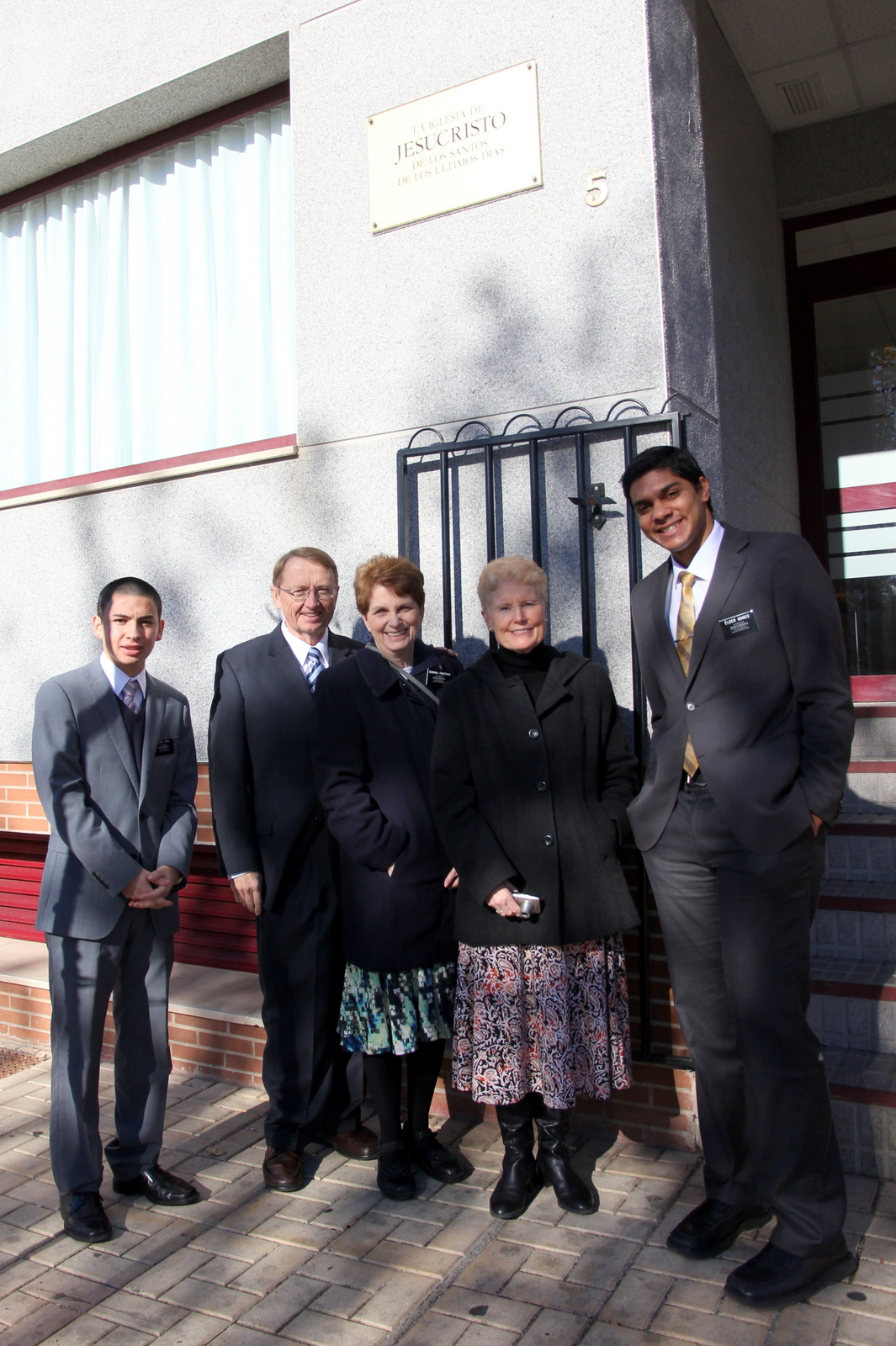
The next day was Sunday, so we drove to nearby Cáceres and attended church at the little branch there. Here we are with the two wonderful missionaries from the Spain Málaga Mission, Elder Pina and Elder Gomes:

We went to the historical center of Cáceres. The Plaza Mayor was filled with people and with a huge tent covering a temporary ice-skating rink:

We climbed to the top of the Tower of Bujaco and walked along the old city wall, with its great view of the city:

Then we drove to the historic city of Mérida, which was established by the Roman Empire in 25 B.C. and became the capital of the westernmost province of the Roman Empire, the province of Lusitania in what the Romans called Hispania, which became Spain. This is the longest existing Roman bridge in the world, spanning the Río Guadiana:

The Alcazaba in Mérida is a  9th-century Arab (Muslim) fortification, but on the site of, and using stones from, an earlier Roman fortress:

The most spectacular ruins in Mérida are the Amphitheater and the Theater, a Roman complex built in the 1st century A.D. This is the Amphitheater, which is a gladiator ring:

Scott and Beverly pose in front of the Roman Theater, where theatrical performances were held (and are still held today) as well as Roman senate meetings and other political and social functions:

Mérida also has a Roman Forum, the city center of Roman life in the 1st and 2nd centures A.D. This is the so-called Temple of Diana:

Another spectacular sight in Mérida is the Miracle Aqueduct, also built by the Romans in the first century:

The last stop on our trip was Guadalupe, Spain, located in the Guadalupe Mountains. This is the Royal Monastery of Santa María de Guadalupe (built in the 13th centuy), one of the most sacred sites in Spain and object of Catholic pilgrimages to see the Black Madonna, that the Catholics believe was carved by Saint Luke the Evangelist (the image has turned black from centuries of lamp smoke):

The front facade of the Royal Monastery of Santa María de Guadalupe:

It was an unforgettable trip back into the ancient history of Spain.

Friday, November 30, 2012

Ten Random Trivia About Spain

Arches of the Great Mosque of Córdoba
 Random facts about Spain:
  1. For 800 years, the Moors (Spanish Muslims from Arabic countries in northern Africa) ruled in Spain, which is why there are beautiful Moorish (Arabic) mosques, bridges, castles, and other Arabic structures in Spain.
  2. The Moors allowed peaceful co-existence of Islamic, Christian, and Jewish religions. The Christian rulers were not so tolerant.
  3. Spain has more UNESCO World Heritage Sites than any other country in the world except Italy.
  4. 1492 was a key year in the history of Spain. You already know about Columbus, who sailed for the Indies that year. But that is also the year that the Christians finally drove out the Moors. It is also the year that the Christians drove out the Jews.
  5. One euro (€1.0) = US$1.30 on this day, November 30, 2012. A euro buys in Spain about what a dollar buys in the U.S., so the cost of living in Spain is about 30% higher than in the U.S. At the temple, our housing is partially subsidized, so our cost of living is about the same here as it would be on a mission in the U.S.
  6. Dates expressed in numeric form in Spain are day-month-year, a much more logical way than in the U.S. But in the U.S., Scott's birthday is an unforgettable 01-23-45 (012345), but here in Spain it is an ordinary 23-01-45 (230145).
  7. Most Spaniards (as well as people in most other Spanish-speaking countries) have four names: two given names, a paternal last name, and a maternal last name, in that order. Example: José Antonio Gutiérrez Ballesteros. We would call him hermano Gutiérrez, which is his paternal last name. Women don't change their last name when they get married. So we know a married couple (temple workers) who have different last names (Hermano Caso and Hermana Rioja).
  8. The official language of Spain is Spanish, or more properly (according to some authorities), Castillian (Castellano). Regional languages (Co-official) include Basque (Euskara), Catalan (Catalán), Galician (Gallego), and Aranese. Almost everyone who speaks one of these regional languages also speaks Castillian.
  9. Spain is the world's largest producer of olive oil. It produces almost three times as much as Italy, the number 2 country. And Spaniards love it. They put olive oil in almost everything, and seem incredulous and exasperated when we tell them that we don't use olive oil.
  10. Flamenco, for which Spain is famous, is not a dance but a musical form involving singing (actually wailing), hand clapping, often guitar playing, and sometimes dancing.
Just in case you'd like to know.

Wednesday, November 28, 2012

Elders Rigtrup and Levorsen for Dinner

Last night (November 27), we had two new elders in our area over for dinner. They were Elder Max Rigtrup of Washington, D.C., and Elder Colton Levorsen of Draper, Utah. Scott made chicken fajitas:

He tried to make about twice as much as he expected these young missionaries could eat, but they managed to eat almost all of it--each one had three huge fajitas--as well as eating up the fruit salad that Beverly had prepared! They seemed so appreciative, that Beverly sent them home with a batch of fruit salad, a package of corn tortillas, and the leftover fajita filling.

Before leaving, they shared a scripture with us (2 Nephi 2:25), an accompanying spiritual thought, and their testimony, all in excellent Castillian Spanish.

We took their picture before they left:
Elder Max Rigtrup (left) and Elder Colton Levorsen
These are such wonderful, enthusiastic, dedicated missionary. It was a joy to get to know them.

Saturday, November 24, 2012

Guadalajara, Spain: City of "No Aesthetic Interest"?

On our day off Monday, November 12, 2012, we wanted to visit a city close to Madrid (that we hadn't visited previously). We reluctantly chose Guadalajara, a city that is hardly mentioned in travel books on Spain. In fact, one of our travel books says, "Despite its romantic name, Guadalajara is, disappointingly, a modern, somewhat scruffy city, of more historical than aesthetic interest." In other words, it's an ugly old town. We (Scott, Beverly, and our fellow temple missionary Miriam) went anyway, on a very cold and windy day.

To our amazement, this ugly duckling turned out to be a swan. Okay, that's an overstatement, but after the day warmed up, we had an enjoyable visit. Here are a few pictures of Guadalajara, Spain.

The city has a very nice tourist office, with a helpful staff (one man) and beautiful (free) brochures:

Palacio el Infatado, built in the 1400s as the residence of a Spanish duke; now it's a museum:

Miriam and Beverly at the Torreón (Tower) of Alvar Fáñez, built in the 1300s and now part of a nice park:

Beverly and Miriam in the courtyard of the medieval Palacio de Antonio Mendoza, now a high school:

A closeup of the beautiful tile lining the walls of the courtyard and stairwell:

The Ayuntamiento (City Hall) of Guadalajara, at one end of the nice Plaza Mayor (main square of the city):

An amazing chocolate cake that we spotted in one of the Guadalajara bakeries:

A group of old men strolling through the clean and attractive Parque de San Roque:

The magnificent Panteón de la Condesa de la Vega del Pozo, which looks like an ancient church but which was actually built in the 1800s (in the U.S. this church might be considered old but in Spain it is considered very new):

An Moorish (Islamic) bridge, built in the tenth century A.D. (yes, this is an old bridge):

We found lots of interesting sites in Guadalajara and really enjoyed our visit to this "very ordinary" Spanish city. We're glad we went.

Sunday, November 4, 2012

Madrid Temple Square in the Fall

On a cold (38°F) and cloudy November, Scott took these pictures of the Madrid Temple Square.

Some of the trees are starting to change color:
Add caption
This a picture of the Madrid Temple Square, with our apartment building on the left (barely visible in the upper-left corner, behind the leaves), the stake center on the right, and of course the temple in the middle:

The grounds crew recently removed the summer flowers and planted these lovely yellow fall flowers (lower foreground):

The Madrid Temple Square is beautiful any time of year.