Sunday, February 10, 2013

Best iPad/iPhone Apps for Senior Missionaries

If you have an iDevice (iPad, iPhone, or iPod Touch) and are serving in a Spanish-speaking mission, you undoubtedly use many of its built-in apps, for example:
  • Contacts (to keep information on fellow missionaries, local Church leaders, investigators as well as your friends and family at home)
  • Calendar (to keep track of appointments, meetings, events, birthdays, and holidays)
  • Mail (to receive and send email)
  • Music (to listen to music as well as to hear the missionary tasks in Spanish)
  • Safari (to access the world-wide web)
In addition to these apps (which come with your iDevice), you might also like other apps to help you in your service as a senior missionary. Here is a list of apps that I (Scott) recommend for senior missionaries serving in a Spanish-speaking country.

The Collins Spanish-English Dictionary Translation Dictionary and Verbs is the best Spanish-English English-Spanish dictionary currently available for iDevices. (The Oxford Spanish dictionary is actually the best, but it is no longer available.) Unfortunately, this app is very expensive (around $32). Fortunately, because I bought this app for my iPad, it is free on my other iDevices.

This app, simply called Spanish, is probably the best free Spanish-English English-Spanish dictionary (to remove banner ads, you can buy the app for $0.99). It contains all (or most) of the words in the Collins Spanish dictionary listed above, but it doesn't contain as many examples and explanations of each word.


LDS Gospel Library is absolutely essential for any senior missionary. It includes all the scriptures, many manuals, and many other Church resources. It includes scriptures and manuals in both English and Spanish.


The LDS Scripture Library is expensive but worth the cost. It is more complete than the LDS Gospel Library (in English, but not in Spanish) and has a fantastic search engine if you're looking for a scriptural reference or a quote from the Ensign or from some other Church source (manuals, study guides, etc.).

Navigation (to jump from one scripture to another) is much better than in the LDS Gospel Library, which makes it ideal for finding references fast during Church meetings.

This app also allows you to see the words and sheet music to hymns, to play built-in recordings of the hymns (with or without the words in English only, so it doesn't replace the LDS Music app, described below). The disadvantage of LDS Scriptures Library is that it doesn't contain the manuals in Spanish. That's why I use both of these apps.

Important Note: Whichever app you use, you should learn how to use "tabs" to be able to keep more than one book open at the same time (and even more than one place within the same book). For example, during Sunday School class, I keep open a tab with the instructor's manual, a tab for the main book and chapter of scriptures upon which the current lesson is based, and tabs for additional scriptures and references. I just touch a tab to jump back and forth among these references.

LDS Music is also an essential app. It contains the Church hymn book and the children's song book in English and Spanish. It includes the hymns/songs with just the words or with the words and notes, just as they appear in the printed hymn book.

There are other LDS hymn apps but I think this one is the best.


Pages is invaluable for keeping your missionary journal, writing notes, and creating and opening documents (such as your patriarchal blessing). The documents you create are automatically saved to iCloud, which you can then use on your laptop or desktop to download the documents. Even if you lose your iDevice and your laptop, your documents are still safe on iCloud.


I use Converter Plus (Universal) almost daily to convert between dollars and euros, between pounds and kilos, between miles and kilometers, and between Fahrenheit and Celsius temperatures. I often use it to convert from liters, centimeters, and milliliters to quarts, gallons, and ounces or even to tablespoons and cups (or any other measure of volume).

You can use the app completely off line, but if you are online, it will automatically update the exchange rate of the currencies. Because the relative value of the euro and dollar change regularly, this is a nice feature.


If you live in Madrid, Madrid Metro by mxData is a great app for using the metro. It contains the metro map and also allows you to find out how to go from one metro station to another metro station, and clearly indicates the number of stops and the transfer points. There are metro apps for other cities in Spain (and probably cities in other countries) as well.
I use MapsWithMe Pro almost daily. It is a database of offline maps (so you don't have to be connected to the internet) of every highway, byway, road, and city street in Spain (and other countries). You can zoom in to see individual countries, cities, roads, and streets or zoom out to see the whole world. You can search to find cities, streets, monuments, restaurants, hotels, or many other locations. It is an essential app to help you get around your city and to travel around your mission or your country. This app also allows you to "pin" locations. For example, you can pin the location of your apartment, homes of members and investigators, businesses that you need to visit, or hotels to stay at if/when you travel. I highly recommend this app (there is also a free version that works well).


iBooks is a great app for reading Church literature. Each month, I download the Liahona in Spanish (free!) onto my laptop and then email the resulting PDF file to my iPad. I can then open (and save) the issue in iBooks for reading at a later time. (There is an app called LDS Liahona Español Magazine, but it has an annual subscription fee.) Some of the things that I have in my iBooks include the following: Predicad Mi Evangelio, Jesús el Cristo, Principios del Evangelio (English version as well), Enseñanzas de los Presidentes de la Iglesia (current and past volumes of these Priesthood and Relief Society manuals), Advanced Spanish Grammar, Diccionario de dudas de la lengua española, and Temple Spanish Tasks (and other Provo MTC Spanish task books).


I use the Deseret News app to keep up-to-date with news in Utah and in the Church.
You can't beat the BYUtv app for watching Church TV shows, BYU sports programs, and other shows in streaming video.
I use the ksl.com app to listen to BYU games on the radio, when they aren't available for viewing on BYUtv.


That's my list of invaluable apps that will help you get the most from your iDevice while you are on your mission. If you have questions or comments about these apps, don't hesitate to send me an email (at spain.missionaries@hotmail.com).

Wednesday, February 6, 2013

La Alhambra

La Alhambra is the top-rated attraction in Spain and is listed as number 40 on Hillman's 100 Wonders of the World. In January (when the temple was closed) we visited the Alhambra located in the city of Granada, Andalusia, Spain (within the Sierra Nevada mountain range).

The Alhambra is a Moorish complex of buildings that were originally constructed as a fortress in 889 AD, at the site of an earlier Roman stronghold, and converted into a royal palace in 1333 by Yusuf I, Sultan of Granada. The buildings are famous for their Múdejar (Spanish-Arabic) style architecture and design.
La Alhambra as seen from the San Nicolás viewpoint:

Windows with sacred Muslim inscriptions and patterns on the walls, located in the Mexuar Prayer Hall:

A closeup of patterns on a wall in La Alhambra:

A garden courtyard:


Hall of Kings:

Court of the Lions as viewed from the Hall of Kings:


Scott and Beverly pose at the Court of Los Arrayanes:

The Court of Lions (Patio de Leones):

Beverly in front of wall design and Islamic text::

Closeup of an arch in the Court of the Lions:

Other windows and archway located in the main palace of La Alhambra:


Scott and Beverly pose near an archway, on this very cold day in January:

The spectacular Cupula of the Hall of Los Abencerrajes:

A view of La Alhambra a dusk, as seen from the Albaysín (old Aarbic quarters):

The photos don't begin to capture the beauty and grandeur of La Alhambra. We hope to return when the weather is warmer!

Monday, February 4, 2013

Lunch at Restaurante Botín, Oldest in the World

To celebrate Miriam's birthday, we took her Restaurante Sobrino de Botín, the oldest restaurant in the world. The Botín opened in 1725 on Calle del Cuchillero, Madrid, Spain, and has been in operation ever since then.

This is the ordinary-looking front to the restaurant:

A window at the restaurant displays the Guinness World Records Certificate:

Miriam and Beverly pose in front of the restaurant, with the Guinness certificate behind them:

The three of us chose a table downstairs, because the basement gives a better feel for the age of the restaurant:

Miriam ordered baked chicken:

 Beverly ordered chicken Fricassee:

Scott ordered the specialty of the house, the suckling pig:

The food was expensive but not great (after all, we were paying mainly for the privilege of saying that we ate at the world's oldest restaurant). The main thing is that we had a great time!

Wednesday, January 30, 2013

Missionaries in Tenerife, Canary Islands, Spain

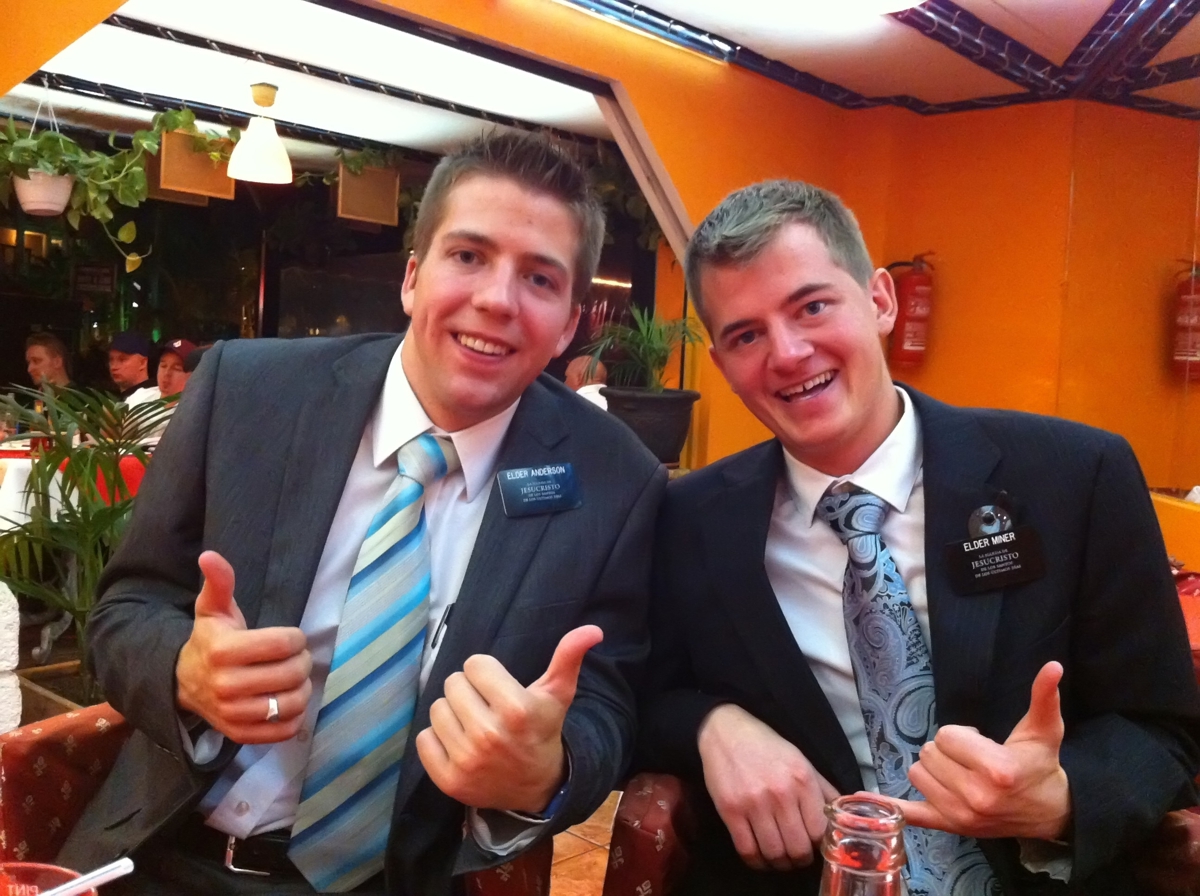
During the semiannual shutdown of the Madrid Temple, we took a side trip to Tenerife, Canary Islands, Spain. We enjoyed going to church at the Los Cristianos Branch. There we met many wonderful members, including the two full-time missionaries serving there. They are Elder Anderson from Springville, Utah, and Elder Miner from Cokeville, Wyoming:
Elder Anderson, Beverly, Scott, and Elder Miner

We chatted with the elders after church and also took them to dinner in the evening (as is our custom when we meet young elders from the Madrid Spain mission). They seemed so appreciative to have a nice steak dinner for a change. Here they are at the restaurant across the street from our hotel in Tenerife:

Elders Anderson and Miner

These missionaries are charming, enthusiastic, and hardworking in bringing souls unto Christ on this amazingly beautiful island off the west coast of Africa. We loved meeting them and spending some time with them.

Sunday, January 6, 2013

Dinner with the Elders and their Chinese Investigators

Sister de Schweinitz invited Scott and Beverly to have dinner with Elders Levorson and Fisher and their Chinese investigators, "William" and "Henry." These two men are graduate students in economics here in Madrid. They don't know Spanish but they do speak English.

William has a friend from China who is a member of the Church and who encouraged him to learn about the Church. So after William moved to Madrid he contacted the missionaries. Both William and Henry are wonderful, sincere men who are seeking the truth.

All of us enjoyed Sister de Schweinitz's fajitas, salads, and dessert. The missionaries and their Chinese investigators expressed appreciation by taking seconds and thirds of the fajitas!

Most importantly, we had a nice gospel discussion of a scripture shared by Elder Levorson, and ended our discussion with a heartfelt prayer by William.

Here we are after the dinner:
Left to right: Sister de Schweinitz, William, Henry, Elder Fisher, Elder Lavorson, Scott, and Beverly

Thursday, January 3, 2013

Vist to El Escorial with Single Adults

On New Year's Day 2013, Scott and Beverly joined with the Single Adults of Madrid (along with single adults from other places, including Granada, Great Britain, and Russia!) on an outing to San Lorenzo de El Escorial, the location of the famous monastery:

We rode from Madrid to El Escorial on a chartered bus, about an hour and a half ride. Three of Beverly's adult piano students were part of the group, including Josefa, who hugged Beverly when she saw her get off the bus:

The group stopped in a park to eat the lunches they brought. Here Miriam and Beverly pose with a group of Latin American members who live in Madrid:

This is a picture of the park with the young single adults sitting at various tables:

Our first stop was the monastery of El Escorial to get pictures of the exterior (the monastery itself was closed). It was freezing cold:

The main purpose of the visit to the town of San Lorenzo de El Escorial was to visit the life-sized Bélen (a depiction of the city of Bethlehem at the time of Christ's birth) which covered several city blocks. The central feature of the Bélen, of course, was this nativity scene:

The huge Belén included a wide range of characters, including this "Bethlehem farmer" who was depicted as wearing glasses!

Beverly stands by a camel being led through the desert:

And Scott stands by one of the three "Wise Men":

The shepherds have a look of surprise and awe at the appearance of an angel announcing the birth of Christ:

The single-adult group, along with the two temple missionary sisters (front and left) posed in front of a huge "elephant":

The group also posed in front of the Monasterio de San Lorenzo de El Escorial:

Here Scott befriends a "horseman" in the Roman army:

We had an enjoyable New Year's Day with the Single Adults at El Escorial.

Tuesday, January 1, 2013

Celebrating New Year's Eve with the Temple Missionaries

The temple missionaries celebrated New Year's Eve together. Everyone brought delicious food:

Several people brought "gambas" (shrimp), but Scott couldn't eat any because he is highly allergic to them:

Everyone was in a party -- and somewhat silly -- mood, as shown here by Bro. Salas:

Even the normally serious Brother and Sister Conesa were in a silly mood:

The Eastmans and the Ebys were somewhat more serious:

Scott, Beverly, and Sister de Schweinitz tried to liven things up by wearing brightly colored wigs, a Spanish New Year's tradition. (Earlier in the evening, when we were at Puerta del Sol, the center of Madrid's New Year's Eve festivities, we saw hundreds of people wearing these crazy wigs, and we couldn't resist joining them):

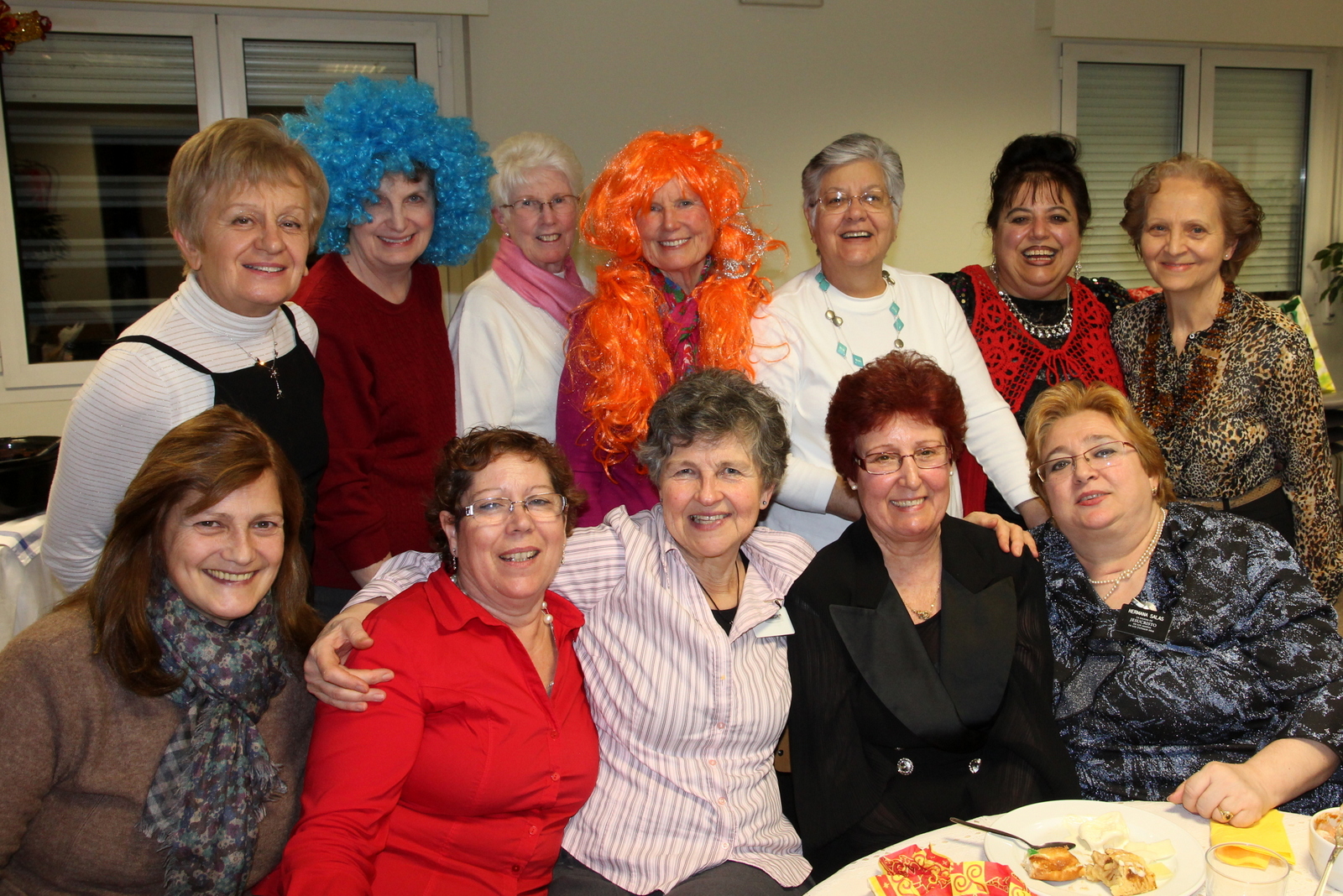
All the sisters at the party enjoyed being with each other:

As midnight approached, we all followed an interesting Spanish New Year's Eve tradition. We took a cup of grapes, and then at midnight, we watched on TV as the bells in the tower at Puerta del Sol chimed twelve times. With each chime we tried to eat a grape (actually we ate half a grape). According to the tradition, everyone who eats a grape with all twelve chimes will be granted their wish for the new year:

After eating the grapes, everyone hugged and kissed and wished each other a Happy New Year. Wearing crazy wigs and counting down the New Year by eating grapes are a fun Spanish tradition that we plan to take back to Utah when we return.